Picking the best city builder games 2026 has on offer is less about ranking and more about matching a game to what you actually want from an evening. The genre has split: some of these are logistics simulations that will have you redesigning a junction at one in the morning, some are survival games wearing a city builder’s coat, and two of them have no fail state at all and exist purely to be pleasant. Buying the wrong one is how people conclude they do not like city builders. This list covers nine worth your time, what each one genuinely demands, and which to avoid if your machine is not new.
Table of Contents
What changed in the genre
For a long time the template was fixed: zone residential, commercial and industrial, lay roads, manage a budget, watch the population tick up. The modern genre has largely abandoned that as the only shape.
Three directions opened up. Survival builders put a clock and a threat behind every decision, so the question stops being how large a city can grow and becomes whether it lasts the winter. Deep logistics builders removed the abstraction, making you model supply chains individually. And a smaller group stripped out failure entirely and kept only the placing of things.
Those three want completely different amounts of attention, which is the single most useful thing to know before buying.
Cities: Skylines II
Still the default recommendation and still the one with the broadest reach. It does the traditional thing at a scale nothing else matches: zoning, road hierarchy, public transport, utilities and economy, across cities large enough that your early decisions become permanent constraints.
Its real subject is traffic. Most players discover that a city which looked fine at forty thousand residents seizes up at ninety thousand, and the resulting redesign is either the best part of the game or the moment you stop playing. There is no middle reaction.
The launch performance problems were real and have been substantially improved, but it remains demanding at scale, and a mid-range machine will slow noticeably on a large city. Start on a relaxed difficulty; the game teaches badly and punishes early mistakes that you cannot see for several hours.
Frostpunk 2
A city builder in structure and a game about governing under pressure in practice. You are managing a city in lethal cold, and the interesting decisions are political rather than spatial: which faction to placate, which law to pass, what you are prepared to do to keep people alive.
The sequel widened the scale from a single settlement to whole districts, which some players felt lost the intimacy of the first game. It gained in return a genuine sense of governing something too large to see all of.
Worth knowing before buying: it is not relaxing, and it is not meant to be. If the appeal of the genre for you is a calm evening arranging streets, this is the wrong one on this list by some distance.
Against the Storm
The most interesting structural idea in the genre right now, and the one most often missed because it does not look like a city builder in screenshots.
You build settlements that are deliberately temporary. A run lasts under an hour, the rain eventually ends it, and progress carries into the next one through permanent upgrades. It is a roguelite built out of city building, and it solves the genre’s oldest problem, which is that most city builders become boring once the city is established and nothing is at stake.
It also suits people who do not have three-hour blocks to give. A settlement fits into a lunch break, which on this list is rare.
Workers & Resources: Soviet Republic
The deep end, and honest about it. You are not zoning anything. You are building a planned economy from raw materials up, and every resource physically exists and has to be moved by a vehicle you bought, on a road you built, driven by a worker who had to get there.
Want a brick factory? Then you need clay, a quarry, trucks, a route, somewhere for the workers to live, a bus to bring them, and a shop for them to spend wages in. Miss one link and the whole chain stops, and the game will not tell you which link it was.
- Expect to lose your first several republics outright
- The tutorial is adequate rather than good; the community guides are better
- Runs on modest hardware, unlike most of this list
- Enormously rewarding if the failure is the interesting part for you
Manor Lords and Timberborn
Two very different games that share a quality: both are built around one idea executed unusually well.
Manor Lords is a medieval settlement builder with organic road growth and a genuine attention to how a mediaeval village actually functioned. Its building and landscape work is among the prettiest in the genre. It remains in development, and the combat and late game are thinner than the early hours, so buy it for the settlement building rather than the battles.
Timberborn is about beavers, water and vertical space, which sounds like a novelty and is not. Damming rivers, storing water against a drought cycle and building upward rather than outward produces a puzzle no other builder offers, and the drought mechanic supplies the stakes that many peaceful builders lack.
Townscaper, Dorfromantik and the quiet end
Neither of these is a simulation and both belong on any serious list, because what a lot of people want from the genre is the placing of things rather than the managing of them.
Townscaper has no goal, no economy and no failure. You click, and an algorithm turns your clicks into a plausible and rather beautiful coastal town. It costs very little, runs on anything, and is the closest the medium comes to a fidget toy.
Dorfromantik adds the lightest possible scoring to hexagonal tile placement and is quietly one of the most relaxing games of the last few years. Both work in ten-minute sessions, which almost nothing else here does.
Banished, and why it survives
More than a decade old, made largely by one person, and still recommended without embarrassment. Banished is a small-scale medieval survival builder where the entire difficulty is food, firewood and the fact that your population will age and die.
Its lasting lesson is that constraint beats scale. There is no combat, no technology tree worth the name, and a handful of building types, and it remains tense throughout because the margin for error is genuinely thin. Many larger games on this list would be improved by its restraint.
It also runs on practically anything, which matters more than it should. A great deal of the genre now assumes recent hardware, and if that is a constraint for you, our round-up of games that run well on low-spec machines covers more in the same situation.
Mods, DLC and the real cost
Two things distort the price of a city builder, and both are easy to miss at the checkout.
The first is downloadable content. Paradox-published builders in particular follow a long-tail model where the base game is the beginning of the spend, and a complete collection several years in can cost three or four times the original price. None of it is required, and the base games stand up on their own, but a sale price on the base game is not the price of the full experience being discussed in forums.
The second is mods, which cut the other way. On Cities: Skylines in particular the modding community has produced tools that most players consider essential, including better road editing, traffic control and an undo function the base game lacks. They are free, and they change the game substantially.
- Check whether the version you are buying supports mods before you commit
- On a modded setup, add mods a few at a time so you can tell which one broke a save
- Expect mods to break after major patches, sometimes for weeks
- Workers & Resources and Timberborn both have active and well-organised mod scenes
Worth saying plainly: a heavily modded city builder is a different game from the one that was reviewed, usually a better one, and occasionally an unstable one. If you want something that works the day you buy it with no maintenance, the self-contained titles on this list suit better.
There is also a hardware cost that sits outside the price tag. Save files in large-scale builders grow steadily, simulation slows as cities expand, and the smoothness that made the first hour pleasant can be gone by hour forty. That is not a bug so much as the genre’s nature, and it is the reason the smaller-scale games here often get played for longer.
Choosing between the best city builder games 2026
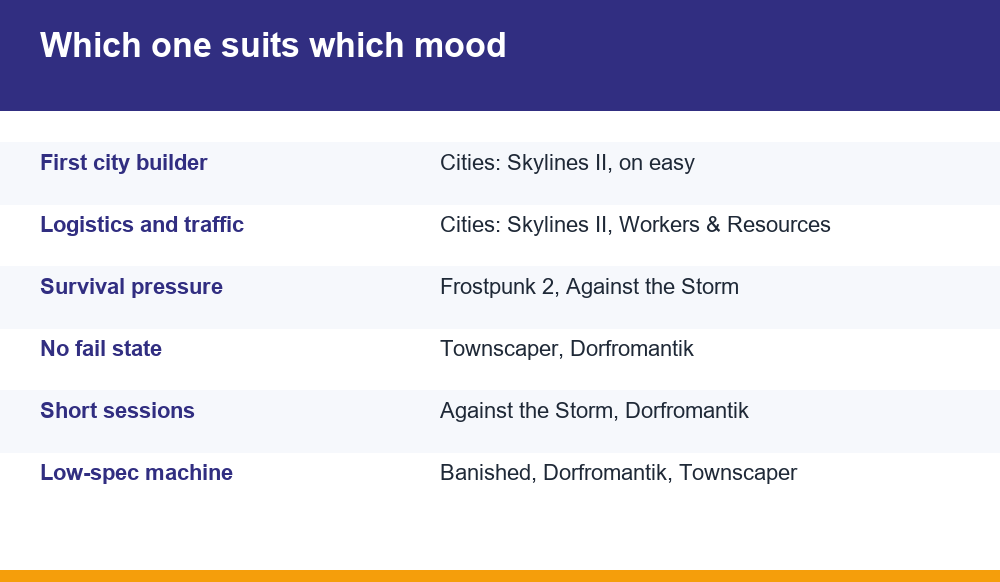
Work backwards from how you want to feel rather than from feature lists, because the best city builder games 2026 offers are separated far more by tone than by mechanics.
| If you want | Start with |
|---|---|
| A big city to manage and perfect | Cities: Skylines II |
| Hard decisions with consequences | Frostpunk 2 |
| Something finishable in an hour | Against the Storm |
| Total depth and no hand-holding | Workers & Resources |
| Beauty and historical texture | Manor Lords |
| A puzzle with a clear hook | Timberborn |
| To switch off entirely | Townscaper or Dorfromantik |
One practical warning that applies across the genre: almost all of these have a difficulty curve concentrated in the first two hours, and most teach themselves poorly. If a builder feels impenetrable early, that is usually the tutorial failing rather than the game being beyond you, and a single community guide tends to fix it.
A note on where to buy and when. City builders discount deeply and often, and several here have been reduced by seventy per cent or more in seasonal sales. Unless you want it this week, the genre rewards waiting, and the exception is a game still in active development, where buying early supports the work and the price typically rises as it approaches release rather than falling.
If you are buying only one and want the lowest chance of regret, Against the Storm is the safest recommendation on this page. It is inexpensive, it runs on almost anything, a session fits an hour, and it is the rare builder that keeps a reason to play after the settlement is working. Cities: Skylines II is the better game if you specifically want a large city to perfect, but it asks considerably more of both your machine and your evening.
Frequently Asked Questions
Which is the best city builder for a complete beginner?
Cities: Skylines II on a relaxed difficulty, because it is the most conventional and the most documented, so help is easy to find. If that feels like too much management, Dorfromantik or Townscaper give you the placing without the simulation.
Do I need a powerful PC for city builders?
For Cities: Skylines II at a large population, yes. Several of the best options run comfortably on modest hardware, including Banished, Timberborn, Dorfromantik and Townscaper, and Workers & Resources is far lighter than its depth suggests.
What is the difference between a city builder and a colony sim?
Mostly scale and focus. City builders manage systems and districts at a distance, while colony sims follow individual inhabitants and their needs. Games like Against the Storm and Banished sit between the two, which is part of their appeal.
Are there good city builders without failure states?
Townscaper has no goals or losing at all, and Dorfromantik only scores you rather than ending the run badly. Most other builders can also be set to a relaxed or sandbox difficulty, which removes most of the pressure without removing the systems.
Is Manor Lords finished?
No, it remains in active development. The settlement building is strong and worth the money on its own, but the combat and the late game are noticeably thinner than the early hours, so buy it for the village rather than the battles.