These soulslike tips for beginners cover the habits that carry over from one game to the next, whatever you pick first. Series guides tell you where the best sword is hidden. This one covers why you keep dying and how to stop.
Table of Contents
Are Soulslike Games Too Hard for Casual Players?
The short answer is no, but they ask for a different kind of attention. In most action games, enemies wait their turn and button mashing works. A soulslike punishes greed. Any enemy can kill you, healing has a limit, and dying costs you something real.
What casual players often miss is that the difficulty is readable. Enemies telegraph their attacks with wind-ups, sounds and stances. Once you start watching instead of reacting in a panic, fights that looked impossible break down into patterns you can learn.
Modern entries are also much friendlier than their reputation. Open-world designs let you leave a boss and come back stronger, co-op summoning lets other players help you, and some games in the wider genre now include proper difficulty settings. If you can afford to die twenty times and enjoy figuring out why, you are not too casual for these games.
What makes the genre feel hard at first
- Limited healing: a fixed number of flask or potion charges per rest.
- Respawning enemies: resting at a checkpoint brings most regular enemies back.
- Currency on death: you drop your experience currency where you fall.
- Commitment: once an attack animation starts, you usually cannot cancel it.
None of these rules is there to be cruel. Limited healing makes every hit matter, respawning enemies let you farm a little currency when you need it, and committed animations mean your timing, not luck, decides the outcome.
Which Soulslike Should You Play First?
Your first game shapes whether the genre clicks. Most soulslike tips for beginners start with the same advice: pick one with an escape valve, meaning a way to go elsewhere, get stronger or call in help when a wall appears. Linear games with a single path forward are the hardest place to start.
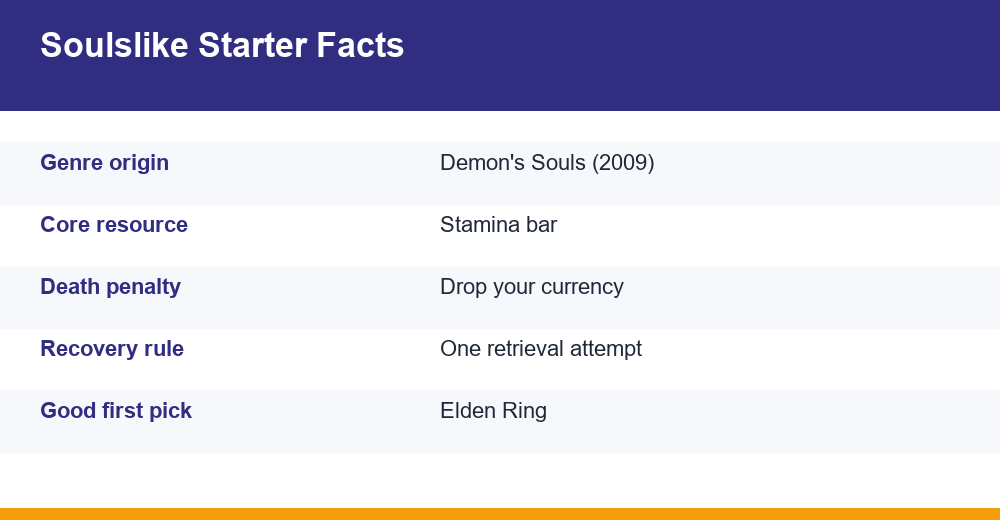
Elden Ring is the most common recommendation, and with good reason. The open map means a stuck player can simply ride off, explore and return with more levels. Spirit Ash summons and online co-op add more ways through. Our ranking of the best soulslike games of 2026 covers the wider field once you have a first win under your belt.
| Game | Why it works for beginners | Main safety net | Start here? |
|---|---|---|---|
| Elden Ring | Open world, explore around blockers | Spirit Ashes, co-op, overleveling | Yes |
| Star Wars Jedi: Fallen Order / Survivor | Familiar setting, readable combat | Selectable difficulty modes | Yes |
| Dark Souls Remastered | Teaches the classic rules cleanly | Co-op summons, multiple routes | Second game |
| Hollow Knight | 2D, easier to read attacks | Explore other areas, charms | Yes, for 2D fans |
| Sekiro: Shadows Die Twice | Superb combat once learned | Very few; no co-op | Not first |
Sekiro deserves a special note. It is brilliant, but it strips out most of the safety nets: no co-op summoning, no character builds in the usual sense, and its combat centres on deflecting. Save it until parry timing feels natural.
The Star Wars Jedi games are worth a mention for anyone nervous about difficulty. They borrow the checkpoint rest, lost-experience rule and deliberate combat of the genre, but let you lower the challenge at any time. Beating one of them is a good confidence builder before a harder game.
Soulslike Tips for Beginners: Stamina, Lock-On and Spacing
If you take only one lesson from these soulslike tips for beginners, make it this: stamina is your real health bar. Attacking, dodging, blocking and sprinting all drain it. Run it dry and you cannot roll away from the next swing, which is how most early deaths happen.
Manage stamina like a budget
- Never empty the bar on offence. Keep enough for at least one dodge.
- Attack in short strings of two or three hits, then back off.
- Stop sprinting before you reach an enemy so you arrive with a full bar.
- Lower your shield when you are not under attack; holding block slows stamina regeneration in many games.
Use lock-on, but know when to drop it
Locking on keeps the camera on one enemy and makes dodges and attacks travel toward it. It is essential for duels. Against groups, or bosses big enough to fill the screen, lock-on can trap the camera at odd angles. Learn to toggle it off and steer the camera yourself when you lose sight of things.
Spacing beats speed
Most attacks have a fixed reach. Standing just outside it, then stepping in after a swing whiffs, is safer than trying to out-trade an enemy. Watch the weapon, not the health bar. Pull single enemies toward you with a thrown item or a bow so you never fight three at once.
Equipment weight matters too. In many of these games, carrying too much slows your dodge into a clumsy roll. Check your load indicator and drop heavy armour pieces if your roll looks sluggish.
Should You Parry or Dodge?
For a new player, the honest answer is to dodge first. Rolling has a generous window in most of these games, works against nearly every attack and only costs a little stamina. A parry is a high-risk, high-reward tool: miss the timing and you take the full hit with nowhere to go.
The exception is games built around deflection. Sekiro centres its combat on blocking at the right moment to break the enemy’s posture, and some other recent soulslikes reward perfect guards heavily. In those games, practise parrying from the start, because dodging alone will not carry you.
| Option | Risk | Reward | Best used when |
|---|---|---|---|
| Dodge roll | Low | Safe repositioning | You are learning a new enemy |
| Shield block | Low to medium | Stops damage, drains stamina | Using a good shield early on |
| Parry or deflect | High | Opening for a critical hit | You know the attack’s timing well |
| Backstep or walk away | Low | Resets the fight | Out of stamina or healing |
A practical approach: dodge through a boss on the first few attempts while you learn its moves. Once you know which attack is coming, try parrying only that one. Expanding your parry list one attack at a time is far less frustrating than trying to parry everything.
Also learn which way to roll. Rolling toward and slightly past a sweeping attack often leaves you behind the enemy, ready to punish. Rolling straight back usually keeps you in range of the follow-up.
How to Get Your Lost Currency Back
The genre’s signature rule is simple and brutal. When you die, you drop all your unspent currency (souls, runes or the game’s equivalent) where you fell. Get back to that spot and touch the marker, and it is yours again. Die on the way, and the first pile is gone for good.
Elden Ring softens this a little: your dropped runes usually appear at or near the spot where you died, and a consumable called the Sacrificial Twig keeps your runes on a death. Sekiro handles it differently, taking a share of your money and experience progress, with a random chance called Unseen Aid that the penalty does not apply. Know your game’s rule before you carry a big stack anywhere dangerous.
A simple retrieval routine
- Spend currency before entering a boss fog or unknown area, even on a small upgrade.
- On the run back, skip enemies when you can. Fighting everything on the path wastes healing.
- Grab the marker first, then retreat to the checkpoint and bank or spend it.
- If the pile sits in a boss arena, decide honestly whether a quick grab is worth the risk.
Above all, treat lost currency as a lesson, not a disaster. Early on, a few thousand runes or souls are easy to earn back in ten minutes. Staying calm keeps you from dying again in a rush to retrieve them.
Forgiving Builds and the Easiest Elden Ring Start
Builds matter less than you think in the first hours, but some choices make life much easier. Forgiving builds share three traits: they keep you away from danger, they hit hard without precise timing, and they leave room for mistakes.
What is the easiest build for beginners in Elden Ring?
Two common starts suit new players. The Astrologer begins with sorcery and lets you attack from range, which turns many close-quarters fights into target practice. The Vagabond or Samurai suit melee players: the Vagabond has sturdy armour and a shield, while the Samurai starts with a strong katana and a longbow.
- Ranged magic: safe distance, simple stat focus on Intelligence.
- Sword and board: a shield that blocks all physical damage forgives bad dodges.
- Heavy armour: more poise means fewer staggers from weak hits.
- Summons: Spirit Ashes pull boss attention away from you.
Whatever you pick, put early levels into Vigor (or your game’s health stat). More health turns one-shot deaths into survivable mistakes, and it helps every build. Upgrading your main weapon also does more for damage than spreading points across many stats.
If you came from online RPGs, a lot of this will feel familiar. The role choices in our MMORPG beginner tips carry over neatly: ranged casters trade defence for distance, tanks trade damage for survival, and the safest build is usually the one that fits how you like to play.
How Do You Get Better at Soulslike Games?
Improvement in this genre comes from deliberate attempts, not from repeating the same mistake faster. Each death should answer a question: which attack hit you, and what could you have done instead?
Habits that speed up learning
- Spend your first attempts on a boss just watching. Dodge and survive rather than attack.
- Learn the one attack that keeps killing you, and ignore the rest for now.
- Heal only when the boss has just finished a long combo or is far away.
- Take breaks. Fatigue causes more deaths than any boss.
Exploration is a skill too. Hidden items, shortcuts and stronger weapons are scattered off the main path. Opening a shortcut back to a checkpoint turns a five-minute run into a thirty-second one, which makes practising a hard section far less painful.
Players who enjoy reaction-based combat in online games often adapt quickly. Fans of the titles in our guide to action combat MMORPGs already know how to read telegraphs and manage dodges, so lean on that instinct and add the patience soulslikes demand.
Finally, use the community features. Messages left by other players warn of ambushes, bloodstains show how others died, and summoning a helper for a tough boss is a design choice the developers built in, not cheating.
Common Beginner Mistakes and Quick Fixes
Most early frustration traces back to the same few habits. The table below collects the mistakes that come up most often, together with simple fixes that need no extra skill.
| Mistake | Why it hurts | Quick fix |
|---|---|---|
| Attacking until stamina is empty | No energy left to dodge | Two or three hits, then reset |
| Healing in front of a boss | Gets punished mid-animation | Heal after a combo or at range |
| Carrying huge currency stacks | One death costs hours | Spend before risky areas |
| Ignoring health upgrades | Bosses one-shot you | Level health early |
| Fighting groups head-on | Attacks from every side | Pull enemies one at a time |
| Rushing after a death | Second death loses the pile | Walk calmly, skip fights |
Run through this list whenever you hit a wall. Most of the time, the fix is a habit rather than a better weapon. That is the core idea behind these soulslike tips for beginners: the game rarely asks for perfect reflexes, only for patience and attention.
Keep these soulslike tips for beginners in mind for your first twenty hours and the genre stops feeling like a punishment. It starts to feel like what it really is: a series of puzzles where you get a little better with every try.
Frequently Asked Questions
Which soulslike should I play first?
Elden Ring is the safest first pick for most players. Its open world lets you leave a hard boss, explore, level up and return stronger, while Spirit Ash summons and online co-op give extra help. If you want selectable difficulty, Star Wars Jedi: Fallen Order or Survivor are gentler options. Leave Sekiro for later, because it has very few safety nets.
Should I parry or dodge in soulslike games?
Beginners should dodge first. Rolling has a generous timing window, works against almost every attack and costs little stamina. A missed parry leaves you wide open to the full hit. Add parries gradually, starting with one attack you know well. The exception is deflection-focused games like Sekiro, where parrying is the core mechanic and should be practised from the beginning.
What is the easiest build for beginners in Elden Ring?
Many new players find a ranged sorcery build from the Astrologer class easiest, since it keeps you out of melee range. For melee, the Vagabond’s armour and shield or the Samurai’s katana and longbow are both forgiving. Whichever you choose, level Vigor early, upgrade one main weapon and use Spirit Ash summons to split boss attention.
Are soulslike games too hard for casual players?
Not usually. The difficulty comes from patience rather than reflexes. Enemies telegraph attacks, patterns repeat and modern entries offer summons, co-op and open areas to explore around obstacles. Casual players who accept that dying is part of learning, take breaks and avoid greedy attacks tend to finish these games. Starting with a forgiving title makes a big difference.