Knowing how to read game reviews is the difference between a purchase you play for months and a refund request two hours in. A single number rarely tells you whether a game suits your hardware, your budget or your taste. This guide shows you how to pull real buying signals out of critic scores, aggregates and player ratings.
Table of Contents
Why a single score misleads
A score is a compression. A reviewer spends 20, 40 or 100 hours with a game, forms a nuanced opinion, and then squeezes it into one figure. Everything that made the opinion useful (what they liked, what annoyed them, what hardware they used) gets lost unless you read the text.
Scales also differ between outlets. Some use 10 points, some use 5 stars, some use no score at all. A 7/10 at one publication can mean “good, recommended”, while another outlet treats anything under 8 as a warning. That is the first lesson in how to read game reviews well: learn the outlet’s scale before you judge the number.
- Genre bias: a strategy specialist and a generalist will score the same 4X game very differently.
- Expectation framing: sequels are judged against their predecessors, new IP against the genre.
- Price framing: a 6/10 at full price may be a great pick at a deep discount or inside a subscription.
That last point matters more every year. If a game sits in a subscription library, the cost of trying it drops to nearly zero, which changes how much a middling score should worry you. Our breakdown of whether Game Pass is worth it in 2026 covers that trade-off in detail. Age ratings are a separate signal from review scores: the ESRB ratings guide explains what each label and content descriptor actually means.
Critic scores vs aggregate scores
An individual critic review is one informed opinion. An aggregate site collects many of those opinions and turns them into a single average. Both are useful, but for different jobs. The critic tells you why; the aggregate tells you how many people agree.
Are Metacritic scores reliable?
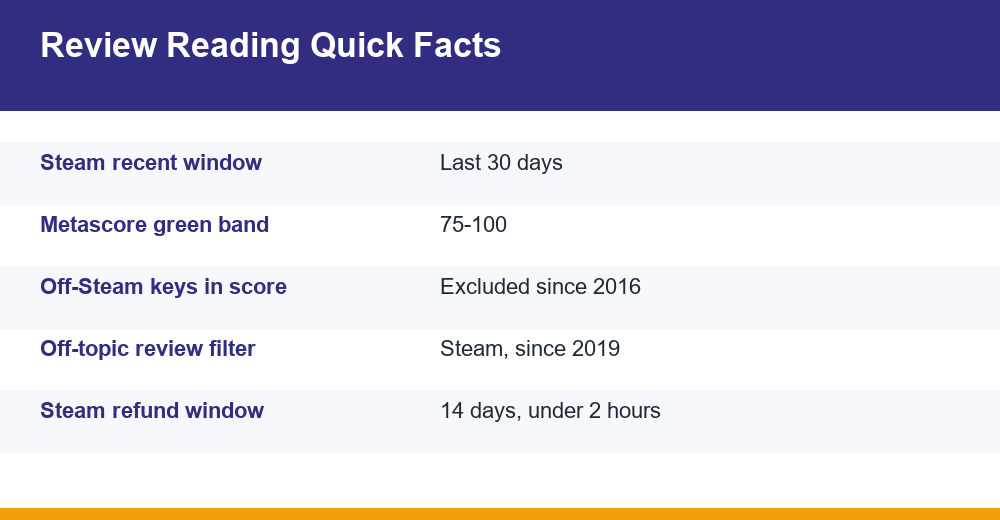
Metacritic’s Metascore is a weighted average of critic scores, and the site does not publish how much weight each outlet carries. For games, the colour bands are green for 75-100, yellow for 50-74 and red for 0-49. The Metascore is reliable as a broad consensus signal, but it flattens disagreement: a game that half the critics loved and half disliked can land on the same number as one everybody found merely fine.
OpenCritic takes a different approach, showing a Top Critic Average plus the percentage of critics who recommend the game. That “percent recommended” figure is often more useful than the average, because it tells you how many reviewers would actually tell a friend to buy it.
| Signal | What it tells you | Main weakness |
|---|---|---|
| Single critic review | Detailed reasoning, specific pros and cons | One person’s taste and hardware |
| Metascore | Broad critic consensus | Hidden weighting, hides disagreement |
| OpenCritic % recommended | Share of critics who would recommend | Depends on outlet coverage |
| Steam user rating | Share of buyers who liked it | Prone to swings, short reviews |
| Steam recent rating | Current state after patches | Small sample for niche games |
If you are wondering how to read game reviews without being misled by an average, the practical move is simple: use the aggregate to decide whether a game deserves a closer look, then read three or four individual reviews, ideally including one positive, one negative and one from an outlet that covers your preferred genre.
What Steam review ratings mean
Steam shows a summary label built from the share of positive user reviews. Every Steam review is a simple thumbs up or thumbs down, so the label measures how many players recommend the game, not how highly they rate it.
The thresholds below are the commonly observed breakpoints. Valve does not publish a formal table, so treat them as approximate.
| Label | Approx. positive share | Typical review count |
|---|---|---|
| Overwhelmingly Positive | 95% or more | 500+ |
| Very Positive | 80% or more | 50+ |
| Positive | 80% or more | 10-49 |
| Mostly Positive | 70-79% | 10+ |
| Mixed | 40-69% | 10+ |
| Mostly Negative | 20-39% | 10+ |
| Negative / Very Negative / Overwhelmingly Negative | Under 20% | Scales with count |
Recent vs all-time ratings
Steam splits the score into Recent Reviews (the last 30 days) and All Reviews. This split is one of the most valuable tools you have. A game that launched broken may show “Mixed” all-time but “Very Positive” recently after a year of fixes. The opposite also happens: a beloved game can slide after a bad update, a monetisation change or dropped support.
- Recent much higher than all-time: the game has likely improved since launch.
- Recent much lower than all-time: something changed. Read the newest reviews to find out what.
- Very few recent reviews: the signal is noisy, so lean on the all-time figure.
Two more details help. Since 2016, reviews from players who activated a key bought outside Steam no longer count toward the headline score, which cuts down on easy manipulation. And you can filter reviews by language, by purchase type and by playtime, so you can read what people with 50+ hours think rather than first-impression rants.
What is review bombing?
Review bombing is a coordinated wave of negative user reviews, usually posted in a short window, that targets something other than the game itself. Common triggers include a publisher’s business decision, a store exclusivity deal, a controversial statement or a pricing change in a region.
Not every flood of negative reviews is a bomb. Players hammering a game for crashing on launch day, or for a new pay-to-win shop, are reviewing the product honestly. The question is whether the complaints describe the experience of playing.
How platforms handle it
Since 2019, Steam has flagged periods of off-topic review activity. When Valve confirms a burst is unrelated to the game, those reviews are excluded from the score by default, though you can opt to include them in your store settings. Steam also shows a review histogram, so you can see spikes with your own eyes.
Metacritic added a waiting period before user reviews open on new game releases, giving people time to actually play first. That does not stop bombing, but it slows the launch-day pile-on.
- Open the review histogram and look for a sharp spike over a few days.
- Read a sample of reviews from that spike.
- Check whether they mention gameplay, performance or content.
- If they mostly cite news or company decisions, discount them for buying purposes.
Positive bombing exists too. Fans sometimes flood a game with praise to counter a negative wave, so apply the same scepticism in both directions.
How to spot sponsored coverage
Paid coverage is not automatically dishonest, but you deserve to know about it. In many markets, advertising rules require clear disclosure when a creator is paid or given something of value in return for coverage.
How can you tell if a game review is sponsored?
- Look for disclosure labels: “sponsored”, “paid partnership”, “#ad” or “in partnership with” near the top of the article or video description.
- Check the tone: no criticisms at all, marketing phrases lifted from press releases, or a heavy focus on a pre-order bonus are warning signs.
- Watch for affiliate pushes: repeated buy links and discount codes signal a commercial interest, even when disclosed.
- Compare with other outlets: a review far above the consensus with no clear reasoning deserves a second look.
Keep one distinction in mind. Most critics receive review codes from publishers, meaning a free copy for testing. That is standard practice and not the same as sponsorship. Good outlets state when a code was provided and, ideally, what platform they played on.
Live-service and free-to-play titles attract the most influencer deals, because publishers need ongoing attention. If you are choosing among them, our list of the best free-to-play games of 2026 focuses on what you actually get without spending.
Patch state and timing context
Modern games change after release, sometimes dramatically. A review written on launch week describes the launch build. Six months later, performance, balance and even core systems may be different.
Part of knowing how to read game reviews is finding out which version was tested. Strong reviews mention the patch number or date, the platform, and the hardware. A PC review without CPU, GPU and resolution details tells you little about how the game will run on your machine.
| Review timing | What to expect | How to use it |
|---|---|---|
| Pre-launch (embargo) | Pre-release build, may lack day-one patch | Good for design and story, weaker on performance |
| Launch week | Real-world bugs and performance | Best snapshot of the launch state |
| Post-patch revisit | Updated verdict on fixes | Most relevant for late buyers |
| Early Access | Unfinished game, roadmap promises | Judge what exists now, not the roadmap |
Monetisation also shifts over time. A game reviewed before its battle pass or premium currency arrived may feel very different today. If a review predates a store overhaul, read up on how the shop works now; our guide to pay-to-win versus pay-to-progress explains what to look for.
At CPD648 we note the build and platform we tested, and we revisit verdicts when a major patch changes the picture, so the score you see reflects the game you would actually buy.
User reviews or critic reviews?
Both groups answer different questions, so the best approach is to read both.
Should you trust user reviews or critic reviews?
Critics usually play more games, compare them against the wider market, and explain their reasoning in depth. Their weakness is timing: they often play before launch, on review builds, sometimes under deadline pressure. They may also burn through a game faster than a normal player would.
Players, by contrast, report on long-term value: endgame grind, server stability, community health, and whether a game still feels fair after 200 hours. Their weakness is volume over depth. Many user reviews are one line, emotional, or about issues unrelated to play.
- For story-driven single-player games, critic reviews are usually the better guide.
- For multiplayer, live-service and survival games, recent user reviews often matter more.
- For niche genres, find a critic or creator who specialises in that genre.
- For performance questions, user reviews filtered by your platform or hardware are gold.
When critics and players strongly disagree, read why. A big gap often reveals the real story: critics praising ambition while players report crashes, or critics finding a game shallow while fans adore its loop.
How to read game reviews: a 7-step checklist
Here is the routine we recommend before any purchase. It takes about ten minutes and saves a lot of regret, because no single number gets to decide for you.
- Check the aggregate first to see whether the game is broadly well received or divisive.
- Read three to four individual reviews, including at least one negative one.
- Compare recent and all-time Steam ratings to see whether the game is improving or declining.
- Scan the review histogram for spikes and check whether they are off-topic.
- Look for disclosures on any review or video that seems unusually glowing.
- Confirm the tested build and platform, especially for PC performance claims.
- Match the verdict to your situation: your hardware, your budget, your favourite genres and how long you plan to play.
Finally, remember your safety nets. Steam’s refund policy generally covers requests within 14 days of purchase and under two hours of playtime, so a short test is often possible. Free trials, demos and subscription libraries let you check a game yourself before committing full price.
Once you know how to read game reviews properly, scores become a starting point rather than a verdict. Read the reasoning, check the context, and trust the reviewers whose taste has matched yours in the past. That habit will steer you clear of bad buys far more reliably than chasing the highest number on the page.
Frequently Asked Questions
Are Metacritic scores reliable?
Metascores are a reliable broad indicator of critic consensus, but they are weighted averages with undisclosed weights, and they hide disagreement. A divisive game and a merely average one can share a score. Use the Metascore to shortlist games, then read individual reviews from outlets whose taste and genre focus match yours before buying.
What do Steam review ratings mean?
Steam ratings show the share of users who recommended a game with a thumbs up. Labels range from Overwhelmingly Positive to Overwhelmingly Negative, depending on the positive percentage and review count. Recent Reviews cover the last 30 days, so compare them with All Reviews to see whether the game is improving or slipping.
What is review bombing?
Review bombing is a coordinated flood of negative user reviews aimed at something other than the gameplay, such as a publisher decision, pricing change or controversy. Steam flags confirmed off-topic review periods and excludes them from the score by default. Check the histogram and read reviews from any spike before letting them influence a purchase.
Should you trust user reviews or critic reviews?
Trust both for different things. Critics give in-depth analysis and market context, which suits story-driven and single-player games. Players reveal long-term value, server health and grind, which matters most for multiplayer and live-service titles. When the two groups disagree sharply, reading the reasons usually exposes the real strengths and problems.